An office cleanout rarely follows a neat schedule. A relocation may leave furniture and equipment behind, while a renovation can add fixtures, flooring, and heavy debris to the same project. An office cleanout dumpster Nashville businesses can load over time gives a manager more control when the work spans several days.
Book your office cleanout service online
Quick answer: A dumpster is usually the better fit when your team, movers, or contractors can load debris over time. Full-service junk removal is often more practical when you need a crew to lift, sort, and haul everything during one concentrated work window.
Dumpsters On Demand offers both approaches. Its driveway-friendly 15-yard roll-off supports self-service cleanouts, while full-service removal adds professional labor. The right choice depends on material volume, loading labor, building access, and the amount of disruption your business can absorb.
When an Office Cleanout Dumpster Nashville Plan Makes Sense
Best fit: Choose a dumpster when your business has reliable loading help and needs a container available while the cleanout progresses.
Start with the loading question. A dumpster gives your business a container and a place to put approved debris as the project progresses. Your employees, movers, vendors, or contractors do the lifting and loading. That arrangement works well when the office is being cleared in phases or when a renovation crew is already on site.
Full-service junk removal changes the labor equation. A crew handles lifting and loading. This can be valuable when employees need to keep serving customers, furniture is bulky, or the building has stairs and long carry routes. The tradeoff is that the project depends more on a coordinated crew visit and a clearly defined removal scope. The company’s Nashville junk removal service is a better starting point when your priority is hands-off hauling.
| Decision factor | Dumpster rental | Full-service removal |
|---|---|---|
| Loading labor | Your team, movers, or contractors load the container. | A removal crew handles lifting and loading. |
| Project pace | Useful for phased cleanouts and renovations over several days. | Useful when the space must be cleared in one concentrated window. |
| Manager involvement | Coordinate placement, access, sorting, and pickup timing. | Define the scope and access, then let the crew handle the physical work. |
| Best cost question | How much material will be removed, and how long will loading take? | How much labor and coordination will the crew save? |
Choose the dumpster route when you have reliable labor and want to control the sequence. Choose full-service removal when speed, labor savings, or difficult access matters more than keeping a container on site. If the project combines both needs, separate the scope. Use a dumpster for staged renovation debris and schedule crew removal for heavy furniture or items your team cannot safely move.
How to Budget an Office Cleanout Dumpster Nashville Project
Budget baseline: Nashville Metro 15-yard dumpster rentals are currently published at $349 for one day, $375 for three days, $399 for seven days, and $525 for fourteen days. Each option includes two tons.
Dumpsters On Demand publishes Nashville Metro pricing for its 15-yard roll-off by rental period. The current rates are $349 for one day, $375 for three days, $399 for seven days, and $525 for fourteen days. Each rate includes up to two tons. Material above that allowance is charged at $125 per ton.
| Rental period | Published price | Included weight |
|---|---|---|
| 1 day | $349 | 2 tons |
| 3 days | $375 | 2 tons |
| 7 days | $399 | 2 tons |
| 14 days | $525 | 2 tons |
These rates help a business build a starting budget before the cleanout begins. They do not remove the need to estimate the material mix. Desks, shelving, carpet, drywall, and masonry do not have the same weight profile. A renovation with dense flooring or rubble may approach the included weight faster than a furniture-only move-out.
Match the rental period to the work plan. A coordinated move-out may fit one day. A multi-tenant office or phased renovation may need three, seven, or fourteen days. Choose enough time to load safely, but do not reserve a long rental period without a reason. A site contact should also confirm the pickup process before the first item is loaded.
For current container options, review the Nashville dumpster rental information. If you need a crew to remove and load the material, compare that scope separately rather than treating labor-based removal as the same service. For offices in Wilson County, see our dumpster rental in Lebanon, TN page for local roll-off service.
Why Nashville Office Projects Fit a 15-Yard Dumpster
Right-sizing principle: A 15-yard roll-off can suit a moderate office cleanout with mixed furniture and renovation debris. The site still needs room for safe delivery and loading.
Office cleanouts often contain a mixed load. One room may produce desks and chairs. Another may produce shelving, carpet, fixtures, or renovation debris. A 15-yard roll-off offers a middle-ground capacity for many moderate cleanouts without automatically taking more parking or loading space than the site can spare.
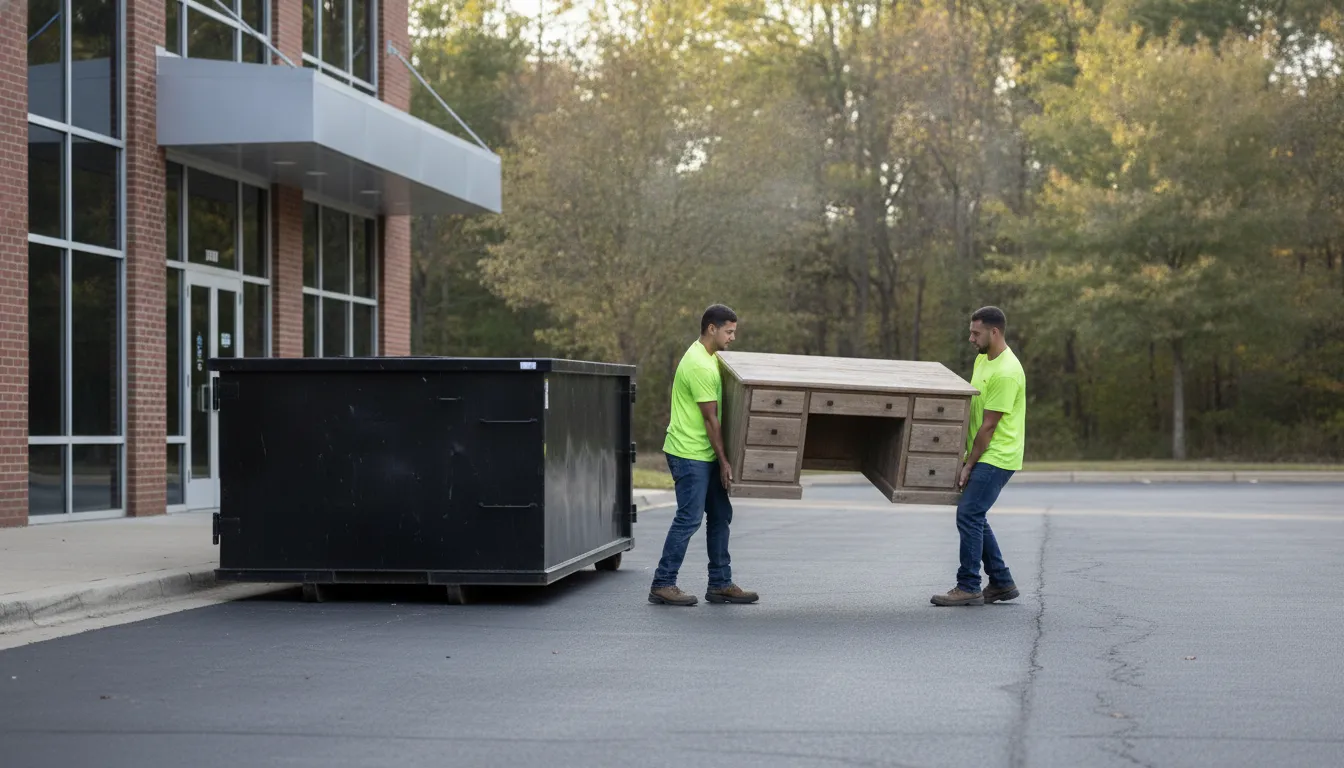
The unit measures 12 feet long, 8 feet wide, and 4.5 feet high. It holds 15 cubic yards and includes two tons in the base rental price. Dumpsters On Demand positions this container as a right-sized option for business projects that need more room than a small container but do not justify a larger footprint. See the 15-yard dumpster for business page for the company’s commercial positioning.
Estimate volume before delivery
Walk every room and list the items that will leave the property. Count workstations, conference tables, cabinets, chairs, cubicle panels, boxes, carpet, and fixtures. Then identify demolition materials separately. This inventory gives the provider a better picture of your load than calling the project simply an office cleanout.
Do not treat a 15-yard container as a universal answer. An unusually large demolition, a full-building move, or a dense masonry load may require a different plan. Ask for guidance when the volume or material is difficult to estimate.
Confirm the delivery footprint
Driveway-friendly describes the container design, not a guarantee that every commercial site is ready. Check the approach route, gate width, overhead branches, pavement condition, loading zone, and truck clearance. Confirm that placement will not block fire access, accessible parking, employee entrances, tenant traffic, or delivery routes.
For a multi-tenant building, get approval from the property manager before scheduling. Mark the approved location and share it with the driver, movers, and staff. A clear placement plan prevents the container from becoming a source of avoidable delay.
How Do You Plan an Office Cleanout Without Disrupting Work?
Planning answer: Assign one site contact, sort items before delivery, map the loading route, schedule around building activity, and decide who will request pickup.
A cleanout can move quickly without turning a working office into a job site. Assign one decision-maker, separate reusable assets from disposal, and plan the loading route before delivery. Use this sequence for a relocation, renovation, or commercial move-out:
- Designate a site contact. Give one manager responsibility for access, placement, delivery questions, and pickup. Share the schedule with tenants, movers, employees, and contractors.
- Inventory and sort first. Create separate groups for items to keep, items to reuse or donate, recyclable materials, approved disposal, and questionable items. Keep confidential records, electronics, batteries, and chemicals out of the general loading area until their handling is confirmed.
- Map the loading route. Measure the truck approach and identify doors, elevators, security checkpoints, low branches, stairs, and cart paths. Keep public walkways and emergency routes clear.
- Schedule around building activity. Notify occupants about delivery, expected noise, loading routes, and pickup. An off-peak window may reduce conflicts in a busy multi-tenant property.
- Set the pickup trigger. Decide who will request pickup, what date to target, and how much access must remain around the container. Do not wait until the last item is loaded to discover that another delivery has taken the loading zone.
Commercial projects may also require local review. Nashville’s Solid Waste Review guidance is a useful starting point for understanding when a project may need additional waste-related coordination. Confirm requirements with the property owner and Metro Nashville before work begins. This article is general planning information, not a permit determination.
What Can Go in an Office Cleanout Dumpster?
Materials answer: Ordinary office furniture and non-hazardous renovation debris may be suitable, while electronics, batteries, chemicals, suspected asbestos, and other questionable materials need a separate handling decision.
Typical office debris may include desks, conference tables, filing cabinets, shelving, office chairs, cubicle panels, carpet, ceiling tiles, drywall, trim, and other non-hazardous renovation materials. Break down large pieces when practical. Keep the load contained and distribute dense material instead of creating one concentrated heavy spot.
Furniture, fixtures, and heavy renovation debris
Dumpsters On Demand accepts concrete, brick, and heavy construction rubble in its 15-yard dumpster, subject to loading and weight requirements. This capability can matter when an office renovation removes masonry, flooring, or other dense material. Heavy debris still affects the two-ton included allowance, so identify it before delivery and ask for guidance when the load is unusually dense.
Fixtures, built-in components, doors, and lighting housings should be reviewed when they contain unusual materials or require special handling. Do not assume that every item removed during demolition belongs in the same container.
Electronics and questionable items
Computers, monitors, printers, servers, batteries, and fluorescent bulbs deserve a separate decision. The EPA’s commercial-building waste guidance recommends planning for reuse, recycling, and responsible management of office materials. Set aside working equipment for reuse or donation and confirm an appropriate e-waste route for items that should not enter a standard dumpster.
Stop before disturbing suspected asbestos, chemicals, pressurized containers, or other hazardous materials. A dumpster rental is not a substitute for a qualified assessment or regulated disposal process. Send a short list or photo of questionable items for review before delivery, then keep approved debris separate from items requiring another route.
How Can Nashville Businesses Reduce Cleanout Waste?
Waste-reduction answer: Sort every item into keep, reuse or donate, recycle, and dispose streams before loading. Early sorting reduces disposal volume and protects usable office assets.
Disposal is only one part of a responsible office cleanout. Before renting a container, divide the inventory into four streams: keep, reuse or donate, recycle, and dispose. This reduces the amount placed in the dumpster and gives usable furniture or equipment a chance to serve another department, location, nonprofit, or community organization.

Start reuse and donation early
Set aside usable desks, chairs, shelving, and equipment before the dumpster arrives. Record basic descriptions and establish a pickup deadline. A firm deadline keeps donation efforts from delaying the move or leaving materials in a hallway.
Make sorting practical
Place collection areas near the work zone for reusable items, cardboard, electronics, and general debris. Give employees a short sorting guide and assign one person to answer questions. Handle batteries, chemicals, and electronic equipment separately until their disposal route is confirmed.
Keep a simple record
Record the cleanout date, material categories, donation recipients, recycling receipts, and disposal provider. This gives a property manager a useful record and helps the business identify waste during its next move or renovation. When remaining debris is ready, a controlled dumpster plan can keep the disposal stream contained while the team finishes the project.
Book the right office cleanout option online
Frequently Asked Questions
Is a dumpster rental or full-service removal better for an office cleanout?
A dumpster is generally better when your team, movers, or contractors can load materials over several days. Full-service removal is generally better when employees cannot safely lift items, the building has difficult access, or the space must be cleared quickly. Compare both labor and timing, not just the advertised service price.
How much does an office cleanout dumpster cost in Nashville?
Current published Nashville Metro pricing for a 15-yard dumpster is $349 for one day, $375 for three days, $399 for seven days, and $525 for fourteen days. Each rate includes two tons. Material above that allowance is charged at $125 per ton. Confirm current terms before booking.
Can office furniture and renovation debris go in the same dumpster?
Many ordinary furniture and non-hazardous renovation materials can be combined, but the material mix still affects weight and safe loading. Dumpsters On Demand accepts concrete, brick, and heavy construction rubble, subject to loading and weight requirements. Ask about unusual fixtures or dense demolition material before loading.
What should a Nashville business do with old electronics?
Separate computers, monitors, printers, servers, batteries, and fluorescent bulbs from general debris. Identify items for reuse or donation, then confirm an appropriate recycling or e-waste route for the rest. Do not assume electronics belong in a standard dumpster simply because they are being removed during an office move.
Does a commercial renovation need Nashville waste paperwork?
It may. Requirements depend on the project, property, and scope of work. Review Metro Nashville Solid Waste Review guidance and ask the property owner or project professional what approvals apply. A general dumpster rental does not replace a project-specific permit or debris-management determination.